
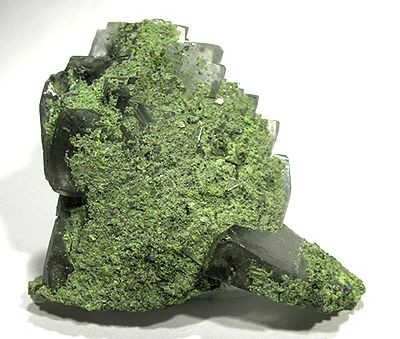
Anglesite
Foto (0)
Nessuna foto ancora.
Descrizione
Anglesite is a mineral consisting of lead sulfate belonging to the barite group. It is a secondary mineral that forms from the alteration of primary lead minerals, principally galena, and is characterized by a remarkable density and a very brilliant adamantine luster.
Characteristics
Anglesite typically presents prismatic or tabular crystals with colors ranging from white to gray and pale yellow. Crystals often show well-developed faces and a transparency ranging from transparent to translucent. Its hardness is approximately 2.5–3 on the Mohs scale, while the density is particularly high, reaching 6.4 g/cm³.
Genesis
This mineral forms primarily as an alteration product of galena in oxidizing environments. It is typically found in the supergene oxidation zones of lead deposits, where sulfate-bearing meteoric waters chemically transform primary sulfides into secondary sulfates that are more stable under surface conditions.
Varieties and curiosities
Anglesite frequently exhibits pseudomorphs after galena, retaining the crystal form of the original mineral. Historically it has been used as a lead ore mineral, though less important than cerussite and galena itself for metal extraction.
Importance for collectors
It is appreciated by collectors for the brilliance of its crystals and their often well-defined form. Museum-quality specimens with transparent, well-formed crystals can reach considerable values, especially when originating from renowned localities.
Italian localities
In Italy anglesite is found mainly in Sardinia, in the mines of the Sulcis-Iglesiente district, where it formed from the alteration of the region's rich galena deposits. Known localities include Monteponi and other historic mines in the area.