
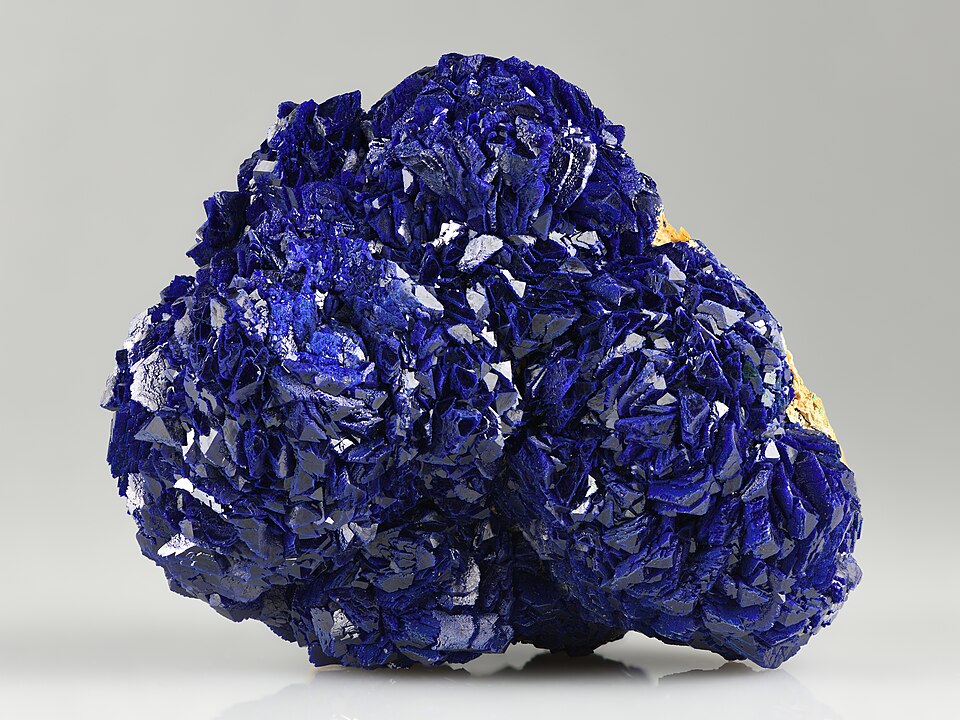
Azurite
Foto (0)
Nessuna foto ancora.
Descrizione
Azurite is a hydrated copper carbonate distinguished by its characteristic intense blue color. This mineral, with chemical formula Cu3(CO3)2(OH)2, represents one of the few basic copper carbonates found in nature and is often associated with malachite, with which it shares origin and formation environments.
Characteristics
Azurite displays a color ranging from intense to dark blue, sometimes with violet reflections. Crystals typically adopt a prismatic or tabular habit, with well-developed faces and vitreous luster. The hardness is relatively low, between 3.5 and 4 on the Mohs scale, while the specific gravity is around 3.8 g/cm³.
Genesis
It forms in the oxidation zones of copper deposits, where solutions rich in carbon dioxide react with primary copper-bearing minerals. Typical environments include the surface portions of copper deposits, where the action of weathering agents promotes secondary alteration processes.
Varieties and curiosities
Azurite has been used since antiquity as a blue pigment for paintings and frescoes, before the introduction of ultramarine blue. It is often found in association with malachite, forming polychromatic aggregates that are highly appreciated. Over time it tends to transform into malachite, a process known as pseudomorphosis.
Importance for collectors
It is highly sought after for its vivid blue color and the beauty of well-formed crystals. The most prized specimens are those with perfect and large crystals, while associations with malachite are particularly appreciated for the contrasting chromatic effect.
Italian localities
In Italy it is found mainly in Sardinia, in the mines of the Sulcis-Iglesiente region, and in Tuscany in the Colline Metallifere. Well-known localities include the mines of Monteponi and Montevecchio in Sardinia, where good-quality specimens associated with other copper minerals are found.