
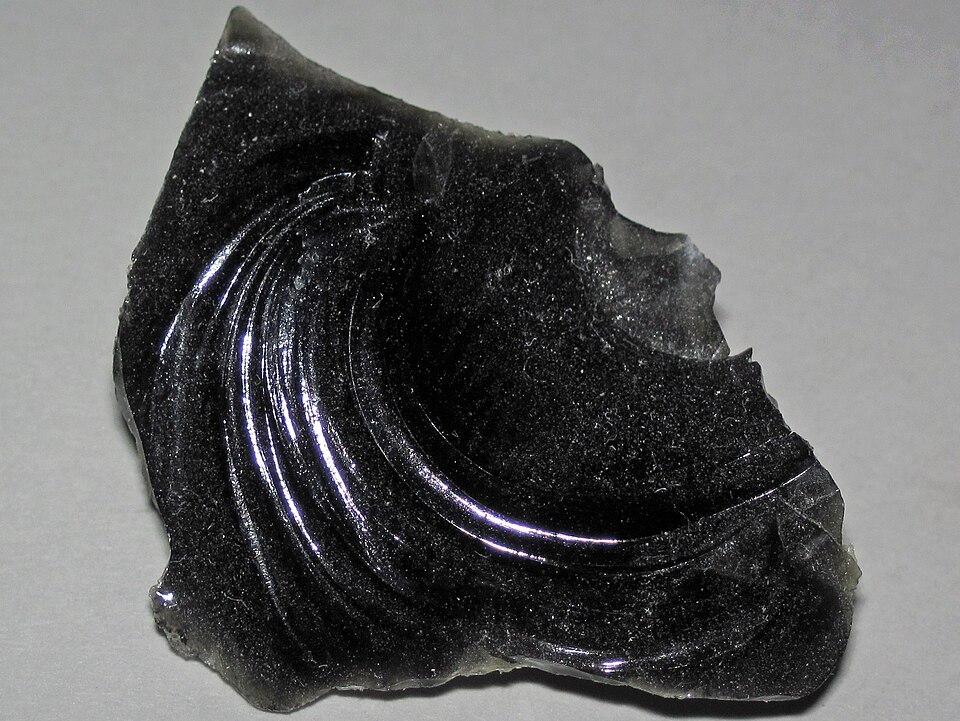
Obsidian
Foto (3)


Descrizione
Obsidian is a natural volcanic glass formed by the extremely rapid cooling of lava. Unlike true minerals, it possesses no ordered crystalline structure: its molecules remain locked in a disorganized network, similar to that of a solidified liquid. For this reason mineralogists classify it as a mineraloid, that is, a substance of mineral origin but lacking crystallinity.
Characteristics
Obsidian typically presents a smooth surface with a very characteristic vitreous luster. The most common color is intense black, but gray and brown varieties exist, as well as ones with golden or silvery reflections. The fracture is conchoidal (similar to that of glass), and the sharp edges that result made it valuable from prehistoric times onward. Hardness is approximately 5–5.5 on the Mohs scale.
Genesis
It forms following the eruption of silica-rich lavas when cooling occurs so rapidly that crystal growth is prevented. This typically happens at the margins of lava flows, along coastlines, or on contact with water. The chemical composition is dominated by silica (above 65% in many cases), with aluminum oxide, iron oxide, and other elements.
Varieties and Curiosities
Among the best-known varieties are rainbow obsidian, with iridescent reflections, and snowflake obsidian, characterized by whitish inclusions of cristobalite. Since the Paleolithic it has been knapped to produce points, blades, and scrapers: some prehistoric obsidian tools display a cutting edge superior to that of metal.
Importance for Collectors
Obsidian is highly appreciated in collections for its immediate aesthetic appeal and the variety of its forms and colors. Pieces with pronounced iridescence or unusual patterns command higher prices. It is not a rare stone in absolute terms, but large specimens of high aesthetic quality are sought after.
Italian Localities
Italy boasts historically important deposits: the islands of Lipari and Pantelleria, off Sicily, are among the best-known obsidian sources in the Mediterranean and were exploited intensively as far back as prehistoric times. Sardinia, in particular Monte Arci, also offers excellent outcrops that are still visited and studied today.