
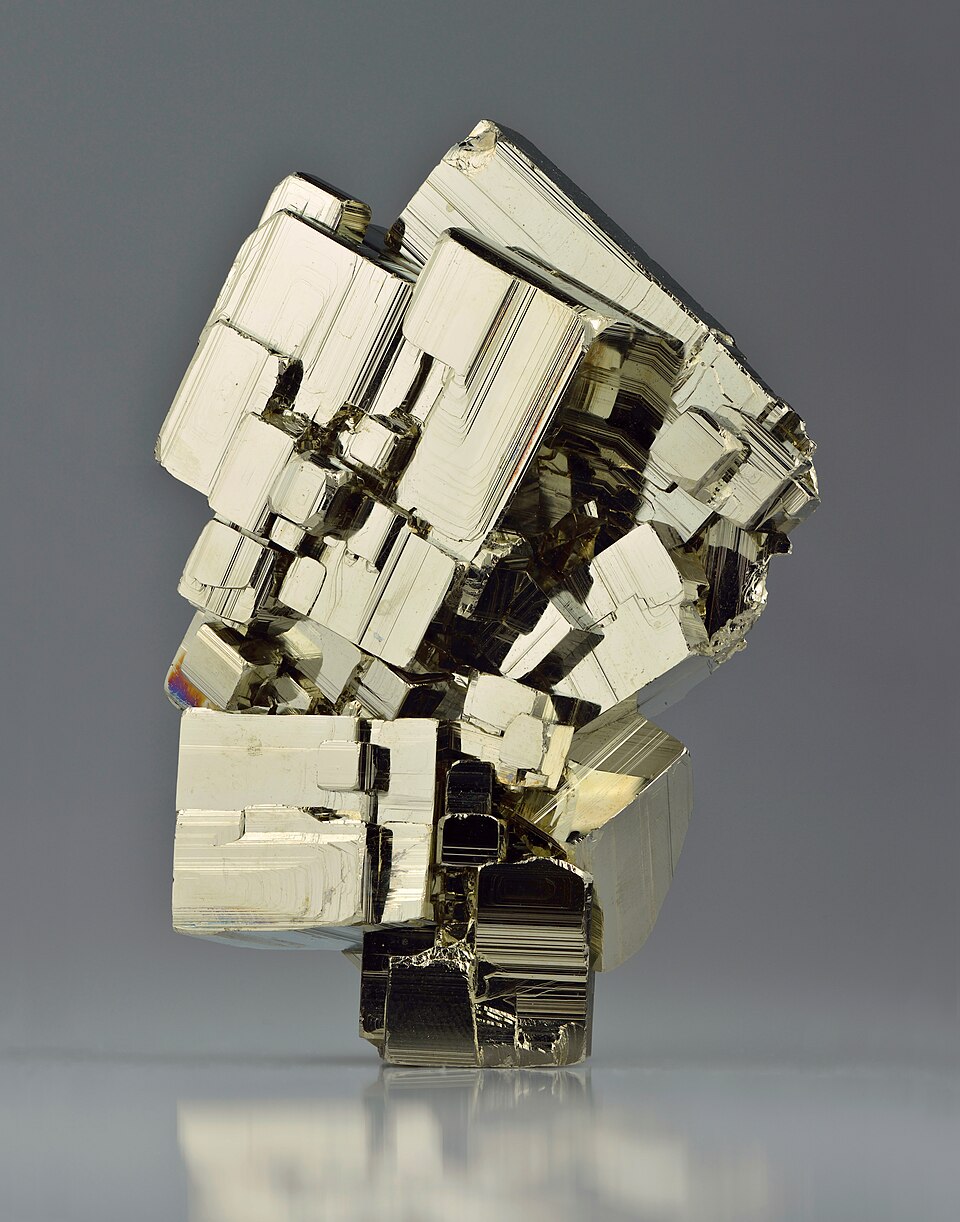
Pyrite
Foto (1)

Descrizione
Pyrite is an iron sulphide with a characteristic golden metallic lustre, often mistaken for gold by inexperienced prospectors, earning it the nickname «fool's gold». This very common mineral has the chemical formula FeS2 and is one of the most widespread sulphides in the Earth's crust.
Characteristics
Pyrite displays a characteristic brass-yellow colour with golden reflections and a brilliant metallic lustre. It crystallises in the cubic system, frequently forming perfect cubes, octahedra or pyritohedra with striated faces. It also occurs as compact masses, nodules or stalactitic forms. Hardness is 6–6.5 on the Mohs scale.
Genesis
It forms in several geological environments: in hydrothermal deposits, in sedimentary rocks rich in organic matter, in metamorphic ore bodies and in volcanic fumaroles. Formation typically occurs under low-oxygen conditions, where iron and sulphur can combine stably.
Varieties and curiosities
Historically it was used to produce sulphuric acid and as a source of sulphur. Today it finds application in the production of sulphur dioxide. Particular varieties include radiated pyrite and spherical nodules known as «pyrite dollars».
Importance for collectors
It is highly valued for its perfect cubes and spectacular lustre. Well-crystallised specimens of large dimensions command high prices. Its tendency to oxidise requires careful conservation to preserve the original brilliance.
Italian localities
In Italy it is found in several regions: notable deposits occur on Elba, in southern Sardinia and in the western Alps. Quality crystals come from the mines of Rio Marina on Elba and from the Sardinian deposits of Iglesias and Monteponi.
Dove si trova in Italia (82 località)
Calabria
Emilia-Romagna
Friuli-Venezia Giulia
Lazio
Lombardia
Marche
Piemonte
Sardegna
Sicilia
Toscana
Trentino-Alto Adige
Valle d'Aosta
Approfondimenti dal magazine
Lapislazzuli: il Blu che Valeva più dell'Oro
Il lapislazzuli non è un minerale ma una roccia a lazurite, calcite e pirite. Storia del blu oltremare che val…
Geodi: Cosa Sono, Come si Formano e Dove Trovarli in Italia
Guida completa ai geodi: cosa sono e come si formano, i tipi (vulcanici, sedimentari, septarie), dove trovarli…
Riconoscere pietre e cristalli: guida pratica per identificare i minerali sul campo
Come riconoscere pietre e cristalli durante un'escursione: i 5 indizi da osservare, i test rapidi da fare sul …
La Miniera di Niccioleta: il tempio della pirite nelle Colline Metallifere
La storia, la geologia e i minerali della miniera di Niccioleta, in Maremma: il più grande giacimento di pirit…
Mappa dell'Oro in Italia: Fiumi Auriferi e Oro Alluvionale
Dove trovare l'oro in Italia: la mappa dei fiumi auriferi (Elvo, Orco, Ticino, Sesia), cos'è l'oro alluvionale…
Come Iniziare una Collezione di Minerali con 100€: La Guida Completa per i Primi 30 Giorni
Con soli 100 euro e un piano di 30 giorni puoi costruire una collezione di minerali seria e rappresentativa. E…