
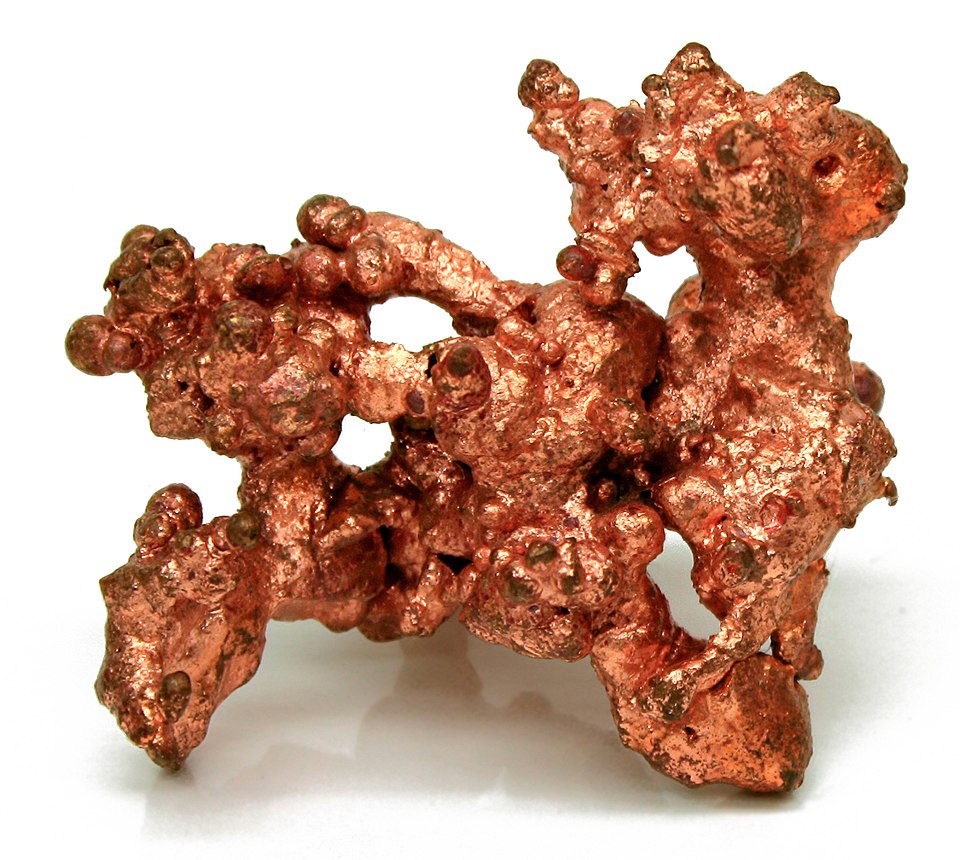
Copper (native)
Foto (0)
Nessuna foto ancora.
Descrizione
Native copper is a mineral consisting almost exclusively of pure metallic copper, with occasional traces of silver, iron, or other metals. It belongs to the class of native elements and represents one of the purest forms in which this metal can be found in nature.
Characteristics
It occurs with the characteristic red-orange color of copper, which tends to oxidize superficially, taking on greenish hues. The crystal habit is rarely well developed: more commonly it forms compact, dendritic, or wire-like masses. The luster is metallic and the hardness is relatively low, approximately 2.5–3 on the Mohs scale.
Genesis
Native copper typically forms in reducing environments, where copper-rich solutions are deposited in the presence of organic matter or reducing gases. It is common in the oxidation zones of copper sulfide deposits and in basic volcanic rocks, often associated with calcite, quartz, and other secondary copper minerals.
Varieties and curiosities
Native copper was one of the first metals used by humans, already in the Neolithic period. Historically, large deposits such as those of Lake Superior in North America provided pure copper for millennia. Dendritic and wire-like forms are particularly appreciated for their aesthetic beauty.
Importance for collectors
It is highly sought after by collectors for its historical value and variety of crystal forms. Well-preserved specimens, free from excessive oxidation, are of particular value. Dendritic forms on matrix are considered among the most decorative and prized.
Italian localities
In Italy it is found mainly in Tuscany, in the ancient mines of the Massa Marittima area and in the Monti Rognosi. Small crystals have also been reported in some Alpine localities of Piedmont and Valle d'Aosta, often associated with sulfide mineralizations.