
Magnetite
Foto (1)
Descrizione
Magnetite is an iron oxide that represents the mineral with the most intense magnetic properties found in nature. Known since antiquity for its ability to attract iron, it takes its name from the Greek region of Magnesia, where it was extracted in ancient times. Its chemical formula is Fe3O4 and it crystallises in the cubic system.
Characteristics
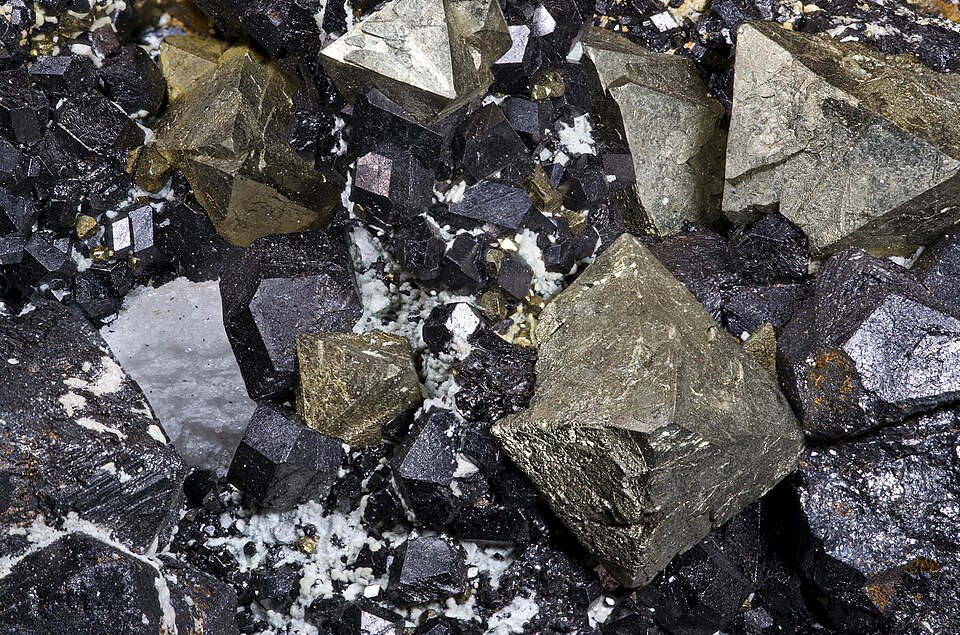
It typically occurs with an intense black colour and metallic lustre. Crystals often adopt an octahedral or dodecahedral habit, but it can also occur as compact or granular masses. Hardness is 5.5–6.5 on the Mohs scale, while density is high, approximately 5.2 g/cm³. The streak is black and the mineral is opaque.
Genesis
Magnetite forms in several geological environments: in igneous rocks as a direct crystallisation product, in contact metamorphic deposits, and as an accessory mineral in sedimentary rocks. It is common in skarns and hydrothermal deposits, often associated with hematite, pyrite and other sulphides.
Varieties and curiosities
Historically used as a «lodestone» for navigation, it is today the principal iron ore mineral at industrial level. Some varieties exhibit particularly intense magnetism, while others display natural magnetic polarity. It is fundamental to the steel industry for the production of steel.
Importance for collectors
Collectors prize above all specimens with well-formed crystals and varieties with strong magnetism. The most sought-after samples are perfect octahedra or masses with distinct crystals. Value depends on crystalline quality and specimen size.
Italian localities
In Italy it is found principally in Piedmont in the mines of Traversella and Cogne, in the Aosta Valley. Excellent specimens also come from the Island of Elba, from the Apuan Alps in Tuscany and from certain localities of the Lombard Alps, where it forms crystals of considerable aesthetic quality.
Dove si trova in Italia (69 località)
Abruzzo
Campania
Emilia-Romagna
Lazio
Liguria
Lombardia
Marche
Piemonte
Puglia
Toscana
Trentino-Alto Adige
Umbria
Valle d'Aosta
Approfondimenti dal magazine
Mappa dell'Oro in Italia: Fiumi Auriferi e Oro Alluvionale
Dove trovare l'oro in Italia: la mappa dei fiumi auriferi (Elvo, Orco, Ticino, Sesia), cos'è l'oro alluvionale…
Demantoide della Val Malenco: la Gemma Verde con la Coda di Cavallo
Il demantoide della Val Malenco è la varietà verde dell'andradite, con una dispersione superiore al diamante. …
Come Identificare le Pietre Minerali Autentiche: Guida Completa per Collezionisti
Come Identificare le Pietre Minerali Autentiche: Guida Completa per Collezionisti Tempo di lettura: 8 minut…